Photo by Jürgen & Thomas/ullstein bild via Getty
Bob Marley has always been a big impact on my culture and my life because my family is from Jamaica, and he represents a piece of that for me. His music was always playing at family gatherings, and it always made me feel connected to my roots, even if I wasn’t born there myself. The way he talked about love, freedom, and unity reminds me of the values my family has passed down, from the way we cook and the food is enjoyed. Listening to him makes me proud of where my family comes from, and it inspires me to carry on that part of my culture.
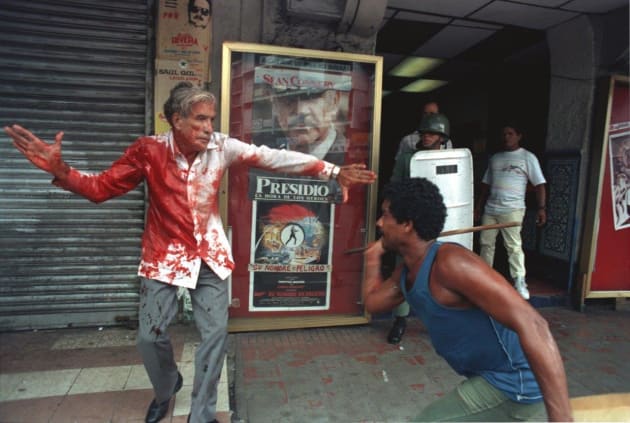
Photo by Ron Haviv
This image by Ron Haviv, was taken in Panama City in May 1989, captures a intense moment in history. Vice President elect Guillermo “Billy” Ford was being brutally attacked by a member of a paramilitary group, supporters of the dictator. Ford is injured, bleeding through his shirt, and his bodyguard has already been killed defending him. What makes this photograph impactful is not just the violence it shows, but what came after. The image was published on front pages and on magazines such as Time, Newsweek, and U.S.This brought attention on what is happening in Panama. When the United States invaded Panama in December 1989, President George H. W. Bush referred to this photograph as part of the justification for intervention. The image became evidence and symbol. The evidence of human rights abuse and suppression, and symbol of democracy’s struggle in Panama.
Ron Haviv’s photograph of Guillermo “Billy” Ford being beaten in Panama, 1989 really shows how one image can change the world. This photo wasn’t just shocking—it spread around the globe and even influenced U.S. decisions about Panama. To me, this proves how powerful photographs can be in shaping the way people think, just like we learned in Module 3 about how images can move people to act. The NPR article about media consolidation also made me think about how only a few companies control what images get seen (NPR, 2012). That makes Haviv’s photo even more important because it broke through those barriers and reached people everywhere.
At the same time, this photo ties into the ideas about censorship. In the article Censorship of War Casualties in the U.S., Ted Rall (2004) explained how violent images are often hidden so the public doesn’t react as strongly. Haviv’s image is the opposite—it forced the world to see the violence that was happening. The example about Time Magazine covers also connects here, since it showed how U.S. media tends to soften the truth compared to international versions. Finally, the Free Press article on media consolidation as a racial justice issue reminded me that access to truthful imagery isn’t just about politics—it’s also about who gets to be represented and whose struggles get hidden (Free Press, 2021). When I look at Haviv’s photo, it doesn’t feel distant or just “history.” It feels like proof that a single image can open eyes, create pressure, and make people act, even when governments or media try to control the story.


Comments
Post a Comment